There has been much talk about Great America lately because, after 50 years, it looks like it is going to close. And what a tremendous loss that would be, and not necessarily for the reason you may think. Great America is more than a theme park, and we will feel its loss for generations.
When the City acquired the land from Marriott through the Santa Clara Redevelopment Agency in 1985, it purchased both the land and the assets. We knew that we wanted to keep a theme park, and we protected it accordingly.
But there have been several transactions since that time that created confusion and underline the thought that “all city land transactions are more than just land transactions and have to be made with a view of the larger vision for the city”. Council members should not be approving sales because of short-term need, and staff should not be suggesting land sales without a larger analysis. It does not seem that the Great America property had either of those guardrails in affect when the city sold the land to Cedar Fair. But it was clear that the Great America property was owned by the Redevelopment Agency, which had been dissolved, and in 2015 the then council (which included Lisa Gillmor, Teresa O’Neill, and other members who has worked with Gillmor & Associates) voted to put Great America on the list to sell. This was a decisive vote, but for many it was just another Tuesday.
If you had bet me a billion dollars in 2007 that I would still be going to city council meetings — as a council member no less — twenty years later, I would have lost a billion dollars. If you had bet me a trillion dollars in 2020 that I would be running for mayor in 2026, I would have bet against that too and lost a trillion dollars. I am not very good at gambling. Which is why I do not do it.
I have learned so much about the city and how city hall works in the past six years of being on council, and what I know for sure is that things need to change. And that change needs to come from the top down.
Fiscal Responsibility: The only sure way to manage finances is to control spend, which seems out of control in a city with a $1.9 billion budget.
Maintenance and Basic Infrastructure: While other cities with a small fraction of our budget reimagine their downtowns and civic centers, Santa Clara struggles to maintain infrastructure and assets like our International Swim Center and Entertainment District while charging the residents with the most need – our youth and senior populations – for services others often provide for free.
Residential Supportive Services: I want to increase the responsiveness of the city to residential issues and build out more residential-supportive retail and activity areas; development should have more planning, and planning involves telling people what we want, and where.
As mayor I will promote local businesses, basic infrastructure, supportive services, individual rights, and the sanctity of all communities. I will refocus on the needs of residents so we do not continue to lose assets like our Downtown, Great America, the International Swim Center, and commercial services that made our city a leader in growth.
As City spokesperson I will cultivate civility and teamwork. I listen to, and am responsible to, the people. Together we will renew the promise of Santa Clara. We will restore vision in development. We will ensure fiscal responsibility and reduce expenditures. We will preserve and expand City resources like our Senior Center, libraries, pools, and parks. Future generations in Santa Clara will have room to grow and reasons to stay.
Let us realize the billion-dollar city that we are, the Center of What is Possible, in the Valley of Heart’s Delight.
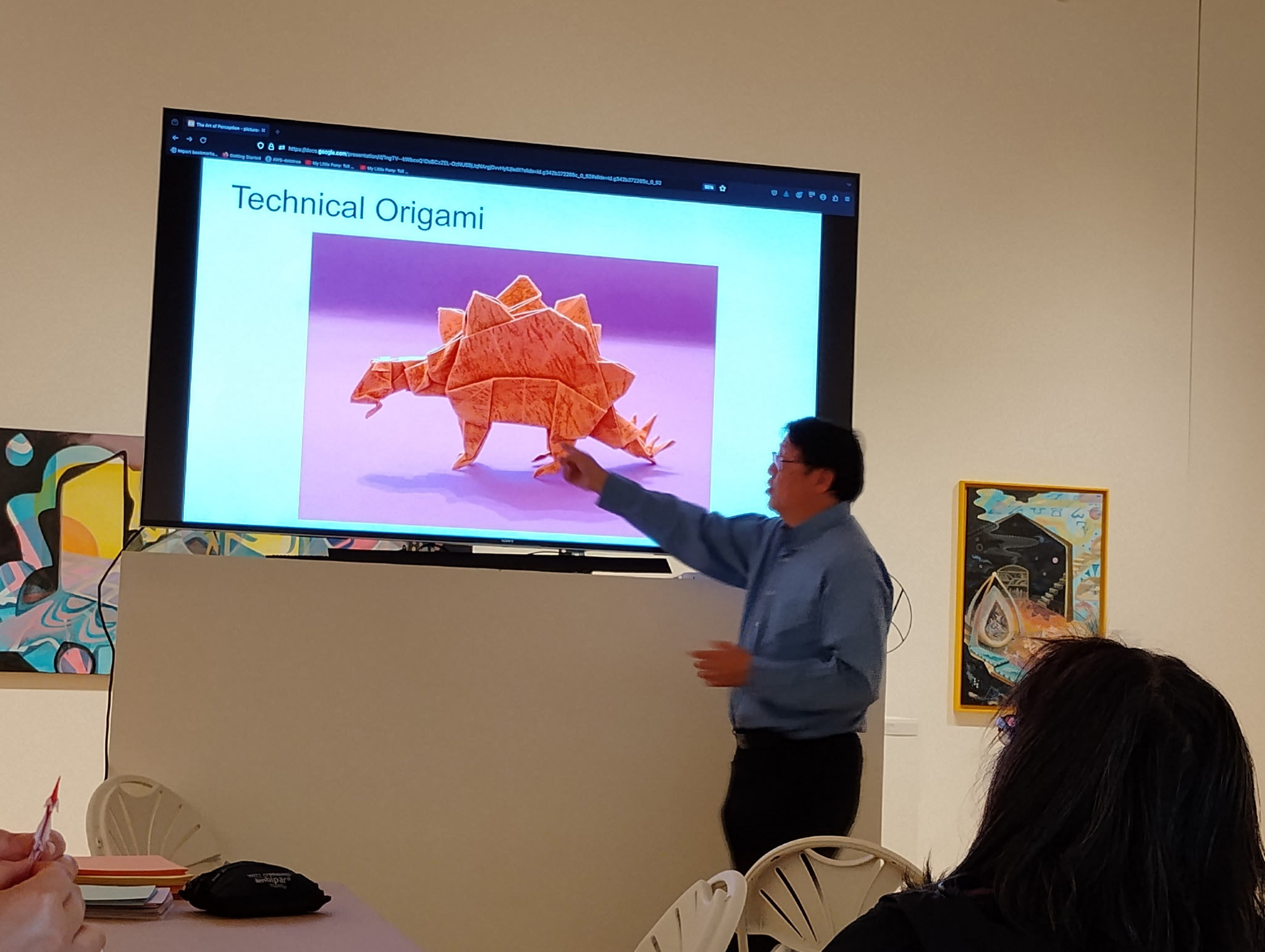
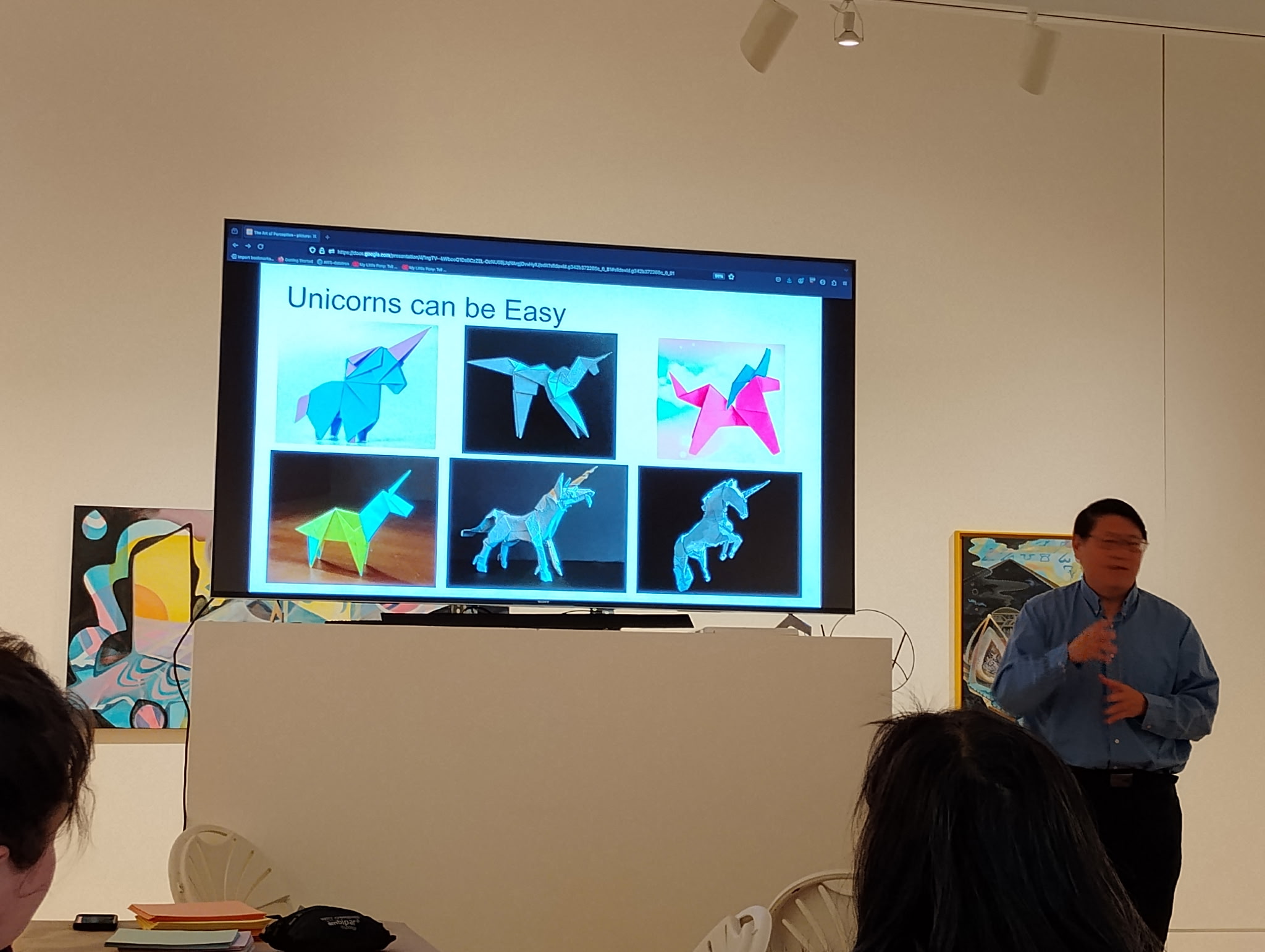
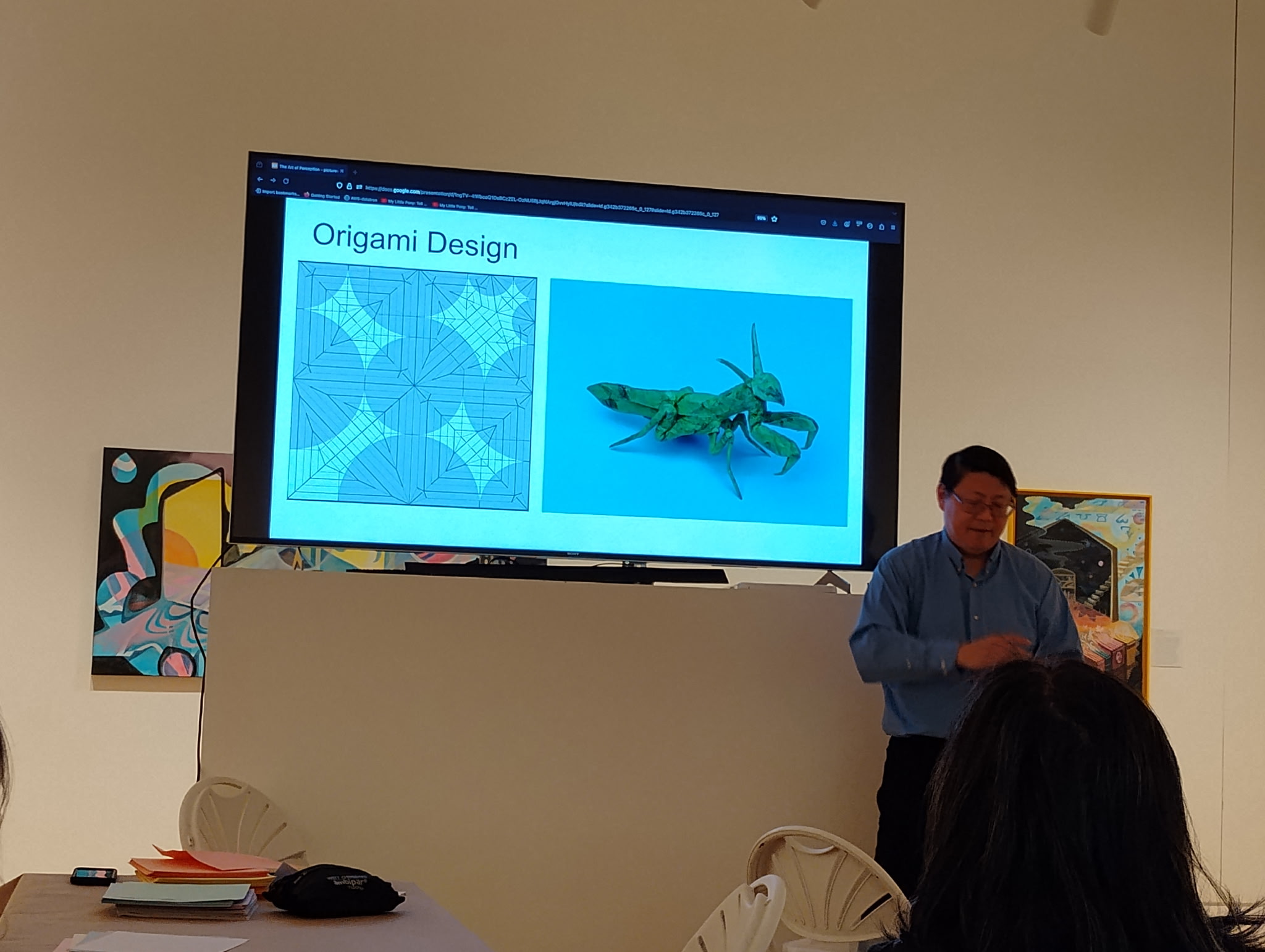
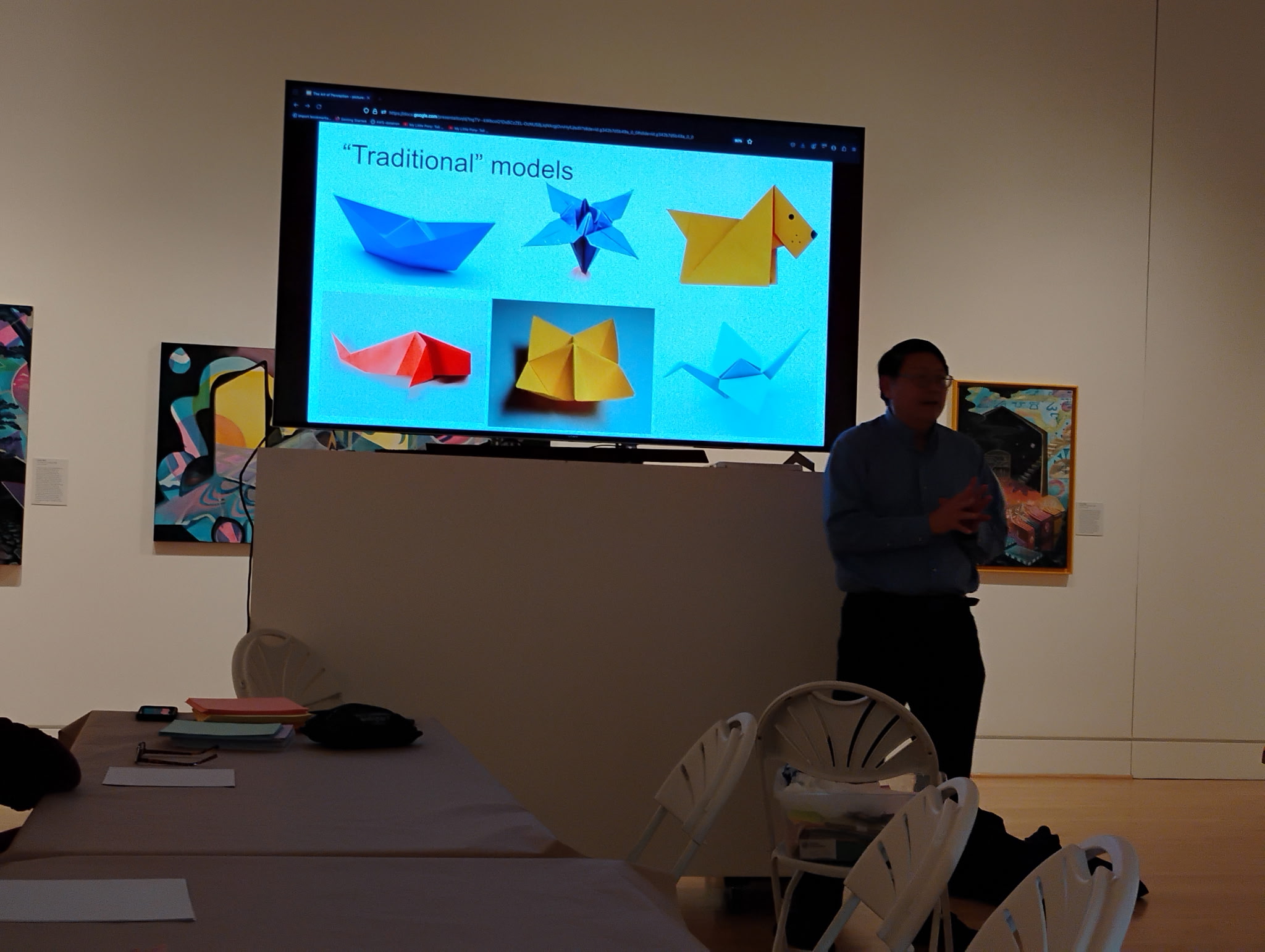
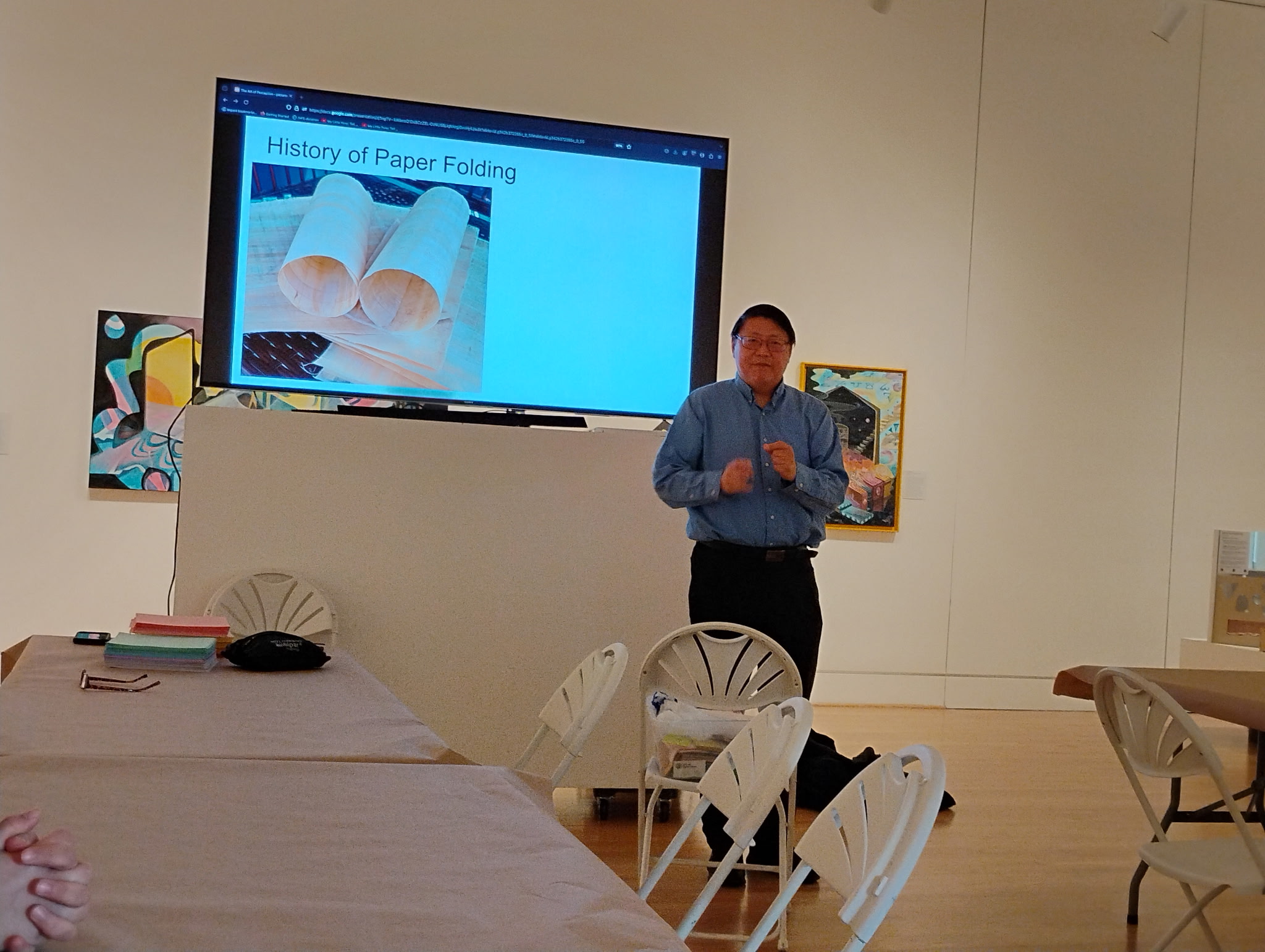
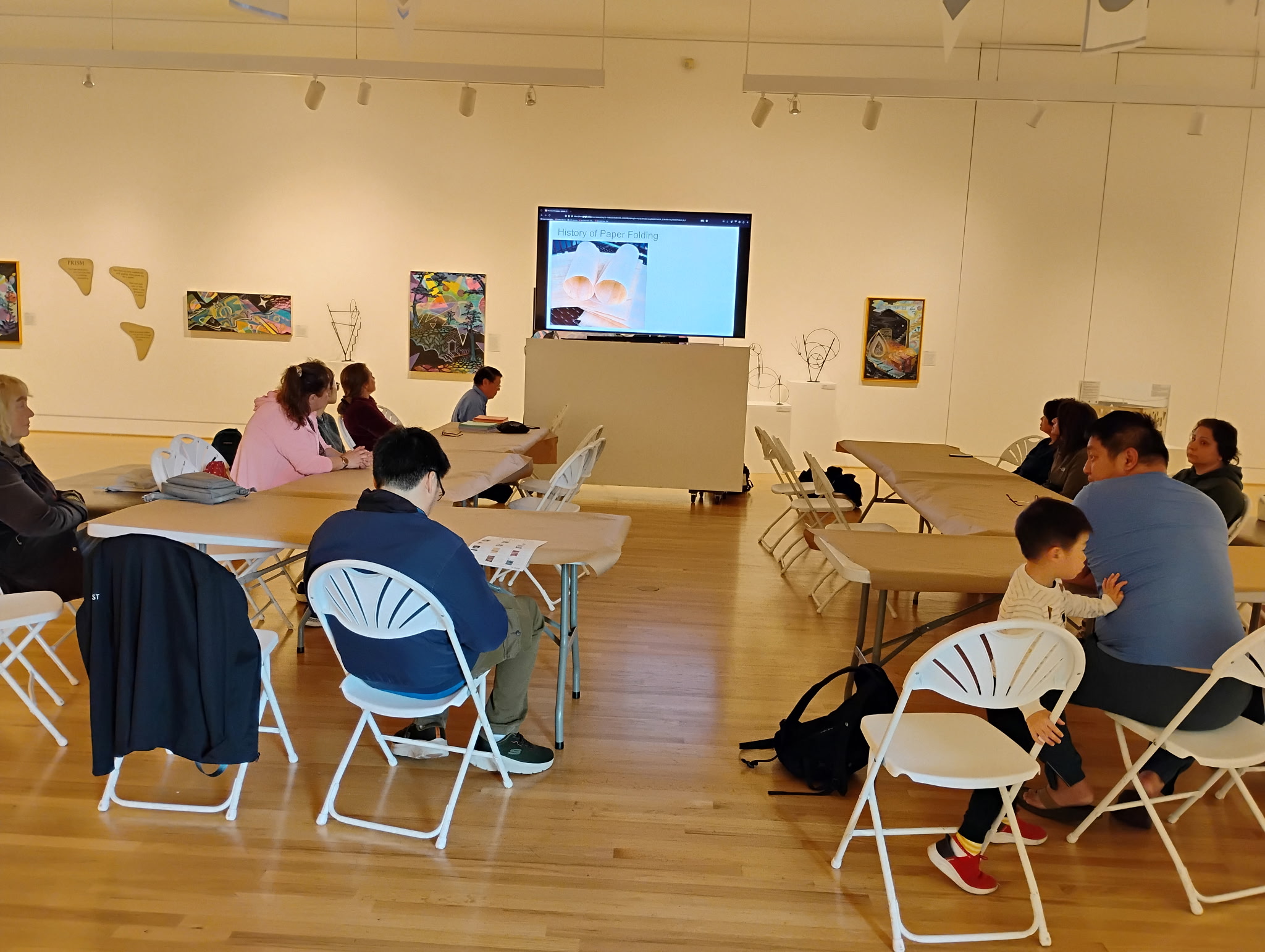
On 22 March 2025, I gave a talk on Origami at the Triton Museum in Santa Clara that touched on the history of paper folding and how it has progressed from ancient times to modern day. While every culture that has paper has a tradition of paper folding, we often use the Japanese term “origami” (literally “fold” and “paper”) because of Akira Yoshizawa’s contributions to the art.
I thank everyone who attended, especially my friend Maria who took the above photos of the event! Thank you all!
The section below was for planning purposes…
Kevin is a scientist and engineer with over 30 years of experience in many high tech companies in Silicon Valley. With degrees in Aero/Astronautics and Mechanical Engineering Design from Caltech and Stanford, he has worked in a variety of technical roles, designing Unix servers for Unisys, developing testing frameworks for startup companies, and working as an engineer on the Enterprise Team at Google. Kevin has also worked in a number of AI companies, most recently serving as the Head of Engineering at a startup specializing in the productionization of machine learning models.
But long before his engineering career, Kevin’s passion for Origami (Korean: 종이 접기) took root in his childhood, shaping the way he sees the world. For him, Origami is not just about folding, it is about perception, about being able to discern prominent aspects and translate them to an audience. Origami is a social experience, and sharing models is just as much about what you see as being able to see through the eyes of others. Through Origami, Kevin has learned to view problems differently, exploring what others may or may not notice in the simplest of subjects. Now, he finds joy not just in the technical aspects of Origami with complex models and realistic designs, but in understanding the unique differences that make each subject distinct in the simplest of terms, and in rediscovering the pure, unadulterated vision of children – and sometimes child-like adults.
“No. I’m sorry, no. This is my event, so no. Thank you anyway. Thank you for being here. I appreciate your support.” –Kathy Watanabe, 31 March 2021
That was the response I received from Santa Clara Councilmember Kathy Watanabe when I asked to say a few words at a #StopAsianHate event she helped stage with Mayor Lisa Gillmor this week at the Northside Branch Library. Although this was organized days earlier, other councilmembers, including myself, were not officially notified or invited until about 24 hours before the event itself. I work during the day and try to be present for my family, but it seemed beneficial for as many minority members of council to support the event as a show of solidarity against recent hate crimes against members of our Asian community. So I went.
In addition to a number of elected guests, including including County Supervisor Susan Ellenberg, Assemblymember Alex Lee, and former Assemblymember Kansen Chu, Councilmembers Anthony Becker and Suds Jain were also in attendance, along with several members of the council-appointed diversity task force. After the guests and task force members gave short messages of support, Councilmember Watanabe made motions to wind down the event. I was not sure if other councilmembers would be given a chance to speak, but there were still about ten minutes left and I had hastily written down a few words. It made sense for a councilmember of the AAPI community for whom the event was held to say something.
Given the dynamics on council, I was prepared to be rebuffed when I approached Kathy, but it was her manner that surprised me. I was not sure how much other people heard at the time, but Susan Ellenberg and Alex Lee were the first to approach me with their condolences. Supervisor Ellenberg was shocked at Kathy’s “tone deaf” comments and feared that they had undermined the messaging of the event. These kinds of comments were not unusual from Kathy, so I took little notice, thinking that only a few people had heard. I had a community meeting to go to and a family to attend, so I took a polite leave and went about my day.
It soon became clear that words matter, and they have repercussions. A flurry of calls and text messages lit up my phone. The next few hours were spent juggling my family and my phone as I tried to piece together what had happened and was happening. After a few media interviews, I took time to reflect. For people who are curious, here are the words I had put together while at the event:
“I am Asian by background. I was born in the United States. The first language I learned, and my primary language, was English. It is funny, but until about five years ago, I considered myself Asian American. But after marrying my wife, who comes from Korea, and having a young daughter whose first language is Korean, I realize I am American Asian, with the American first, and in capital letters. I am learning more and more every day as it is not easy to actually understand their situation.
“And it is not enough to ask, or even demand respect. We must support the processes that make people equal, not just repeat the social acknowledgements that we SHOULD be equal.
“STOP ASIAN HATE — and BLACK LIVES MATTER — are current and historic movements, centered around events that highlight the race and ethnicity of victims, based on the history of our country and our culture of immigration, inviting the “tired, poor, and huddled masses yearning to breathe free.” But let’s be clear. Equality and the political issues that enable, prevent, and surround it, will always be a struggle.
“Let us find ways to find be inclusive and find similarities, proud of our differences, but united in equality. Equal respect. Equal opportunity. Equal protection. And, eventually, equal representation.”
Kathy said it was “her” event, but that is not really true. We will never have change if we allow politics and politicians drive our social causes. This happened because we allowed an event like this to be led by politicians with many secondary and tertiary concerns.
What we can do to make events like this more impactful and less politicized is to put citizens at the forefront and have politicians be the guests supporting such movements.
People have asked if I would set up another event — or have “my own event” in District 4. But having similar events at different times in a city the size of Santa Clara actually detracts from the larger message: Unity. Rather than have politicians host events, even in pairs or groups, it seems better to support citizens and citizen groups, and help their efforts get more reach by using our positions to invite everyone. We should note the elected officials in support, but let the people speak. Of the People, by the People, for the People.
I am reminded of the observation in the song “Alice’s Restaurant” by Arlo Guthrie: if only a few people do something, it may look crazy and people may not take it seriously; but if lots of people do it, it can look like a movement. And that is what we need for society to progress: movement.
Stop Asian Hate. Black Lives Matter. We do not need more ways to divide the victims of prejudice. Equality needs to be more than just a movement, or even a series of movements with uncertain paths. Hate needs to be a point in time, with a definitive end. And when that happens, it certainly will not be Kathy’s event.
For all minorities who have experienced discrimination and hate; For all people who are committed to equal time, representation, and voice; For all friends of oppressed people everywhere: This Is Our Event.
The appellate court has upheld Judge Thomas Kuhnle’s judgment against the City of Santa Clara:
The following transaction has occurred in: Yumori-Kaku et al. v. City of Santa Clara Case: H046696, 6th District
Disposition date (YYYY-MM-DD):
2020-12-30
Disposition description:
Affirmed in full
Disposition status as of 2020-12-30:
Final
Notes: (Signed Published) The judgment of liability under the California Voting Rights Act is affirmed. The award of attorney fees and costs to plaintiffs is also affirmed. Plaintiffs are entitled to their costs on appeal. EMP, FDE, and AMD
I stated during my campaign that I would have preferred if the City of Santa Clara dropped its appeal of the 2018 California Voting Rights Act (CVRA) judgment. As a resident of the city, a tax payer, and someone with ties to many under-represented minority communities, the fact that we did not proactively put in place a voting system that was more fair was disappointing. But the City’s active decisions to fight the CVRA were even more disappointing.
Anyone that has been following the case — or CVRA cases in general — could see that the case the city put up against the plaintiffs was not very strong. The court ruling did not come as a surprise. The appeal case seemed even weaker, as the appellate court justices seemed to affirm during the recent appeal hearing. The people claiming to have attended the appeal hearing who felt that the City had a good chance of winning seemed not to have been listening very closely.
Now we are on the hook — in the absence of any settlement agreement with the plaintiffs — for almost $4 million. That amount does not even include the City’s costs, which are likely add another $1.5 million. If we had accepted the “Safe-Harbor” provision in 2018, we could have limited our damages to $30,000, less than one hundredth of the price we will likely pay. The “Safe-Harbor” provision was the remedy chosen by most California cities, as no city had ever successfully defended a CVRA lawsuit. By the end of this year, over 90 cities will have moved to district elections.
Instead of trying to work with residents and the state on a workable solution, the City single-sidedly ran with a loaded “districting committee” and supported not one but two ballot measures that would have restricted minority voice. The City’s actions, and the ballot measures it put forth, were clearly not desired by the residents. The fact that none of the residents had a say on the lawsuit and were guided to a City-desired outcome for the districts are examples of the lack of citizen voice that led me to run for office.
Here is a short history of how we got here.
The California Voting Rights Act (CVRA) of 2001 addresses vote dilution caused by racial polarization in at-large elections.
The Default solution: Move to district elections.
CVRA added California Elections Code §§ 14026-14032
CVRA was enacted in 2002, effective 1 January 2003
CVRA challenges can apply to any public entity that votes
School and other special districts are also subject to CVRA challenges
Other amendments have been made to the California Elections Code through the years to support CVRA
A “Safe-Harbor” provision was implemented in the Changes to Elections Code Section 10010 (“one hundred ten”), in effect since 1 January 2017.
“Safe harbor” limits attorney’s fees and costs to $30,000
Jurisdictions can change election system upon receipt of a demand letter
Limits attorney’s fees and costs that are recoverable by plaintiff(s)
That is the total payout, regardless of number of plaintiffs
Upon demand letter receipt, city has 45 days to respond
If city adopts a resolution to change elections system, it has 90 days to go through the process for transitioning to districts
Plaintiff is precluded from proceeding with lawsuit during this time
The CVRA case against the City was filed on 30 November 2017 on behalf of Ladonna Yumori-Kaku (with additional plaintiffs). To get to the official documents of the entire lawsuit: https://cmportal.scscourt.org/Portal Type in the Case number 17CV319862 and then select the case number link.
The basic summary of the plaintiffs’ complaint: Since 1951, no minority has been elected to city council of Santa Clara, a city that has a large minority population. (This situation changed in 2018, after the court forced Santa Clara to adopt a new election system and Council Member Raj Chahal was elected, the first Asian-American on City Council in Santa Clara’s history. This history will cover the period prior to the 2018 changes.)
Asian-Americans make up over 30% of the population of eligible voters. Since 2004, ten minority candidates have run for city council without winning.
Plaintiff’s counsel notified city of complaint in June 2011. In response, the City put together a Charter Review Committee to recommend changes to the charter to help avoid a lawsuit. The Charter Review Committee recommended Ranked Choice Voting, but no action was taken by the City at that time.
Plaintiff’s counsel again notified City in October 2016. In 2017, another Charter Review Committee convened, but no recommendations or actions that would address the CVRA violations were offered. Another change of note relating to the City’s legal stance was the hiring of current City Attorney Brian Doyle, who took over in early 2017 after Attorney Ren Nosky’s departure.
Plaintiff’s counsel again notified city in August 2017. The City again took no action.
Plaintiff’s counsel notified city final time in October 2017. The City again took no action, leading to the lawsuit filing in November 2017.
Four(?) Case Management Conferences (CMCs) were held in December 2017 through January 2018 to discuss the lawsuit. There was clearly enough time for discussion on “Safe-Harbor” provision, but the City chose not to go with this option.
On 26 January 2018, the City filed 19 separate affirmative defenses. This effectively canceled the City’s ability to request “Safe Harbor”. In fact, the City’s response came outside the 45-day window for Safe Harbor.
The CVRA lawsuit was presided over by Judge Thomas Kuhnle in Santa Clara County courthouse. After a number of Case Management Conferences discussing liability, the City was found in violation of California Voting Rights Act.
From the 6 June 2018 decision:
“Based on the evidence presented at trial, the Court finds that Plaintiffs have proven by preponderance of the evidence that the at-large method of election used by the City impairs the ability of Asians to elect candidates as result of the dilution and abridgment of their rights as voters. Having found the City liable for Violating the CVRA, this action will now proceed to the remedies phase.”
The decision came after the 5 June 2018 election, but before the final result of Measure A could be deemed complete. The result of Measure A would not have changed the judge’s decision. An appointment to vacant council seat on 12 June 2018 would not have changed the judge’s decision. The issue was not just having a minority city council representative, but fixing the system of voting that prevented minority candidates from obtaining seats fairly in the first place.
As a result of the ruling, the City held four public hearings within a two-week timeframe, as required by Section 10010 (“one hundred ten”) of the California Elections Code. Judge Kuhnle also wanted to meet November election requirements; without the compressed schedule, special elections would be forced based on Registrar of Voters’ requirements to support the election.
Knowing what is required and how long each activity takes, it is a simple matter of working backward to know when the trial must end.
Judge Kuhnle noted the City’s disinterest in settlement, contrary to comments made by City Attorney Brian Doyle. Judge Kuhnle mentioned other cases where Defense worked with Plaintiffs to settle and stated that the Plaintiffs showed a desire to settle. The City’s attorneys did not seem to know what City wanted or would allow.
“I’ll have to discuss with my client.”
Attorneys for the Defense (City of Santa Clara)
I will add/edit more when I have time, but this is basically the history of the CVRA case in a nutshell. Please feel free to contact me to correct any errors or add other information.
Have you ever wondered why the only sites the Gillmor voting bloc can find to support their agenda are blogs run by individuals and not legitimate news sites?
It is because they were set up by Gillmor. And Teresa O’Neill.
Many people glossed over my earlier post on the root of the problem in Santa Clara. But many did not, and were shocked. The blog site that touts itself as a “Santa Clara News” organization is run by a person approached by Gillmor and O’Neill back in 2016, when the full-on assault on truth started in the city.
Back in 2016 Mayor Lisa Gillmor and Councilmember Teresa O’Neill were actively looking for a captive news channel and proposed the project to fired Weekly employee Robert Haugh, according to texts in The Weekly’s possession. [Texts] “Teresa and Lisa are going to take me to lunch sometime next week to discuss news in Santa Clara and ideas how there could be another news medium digital based,” Haugh texted in September 2016.
That was the year that Gillmor took to military tactics and tried to control the media. Not content with just community demagogues, it seems that the council majority bloc also tried to set up an alternative-to-news site that espoused their views and pushed their agenda. And now this site is the main (only?) site that is used by the Police Officers Association PAC and pro-city material to attack the independent candidates.
It’s hard to overstate the need for new faces on the Santa Clara City Council.
To understand why, consider some of the council’s failures: Bungling of the costly voting rights lawsuit against the city; poor relationships with neighboring cities; overpaying of high-ranking staff; and the ongoing, costly legal battles with the San Francisco 49ers over management of Levi’s Stadium. All at considerable expense to Santa Clara taxpayers.
The heart of the problem is that three councilwomen — Kathy Watanabe, Debi Davis and Teresa O’Neill — vote in lockstep with Mayor Lisa Gillmor on Santa Clara issues. Gillmor is smart and knowledgeable. But her combative, “my way or the highway” approach to governing hurts the city. … O’Neill is smart and experienced, but her reputation as an independent thinker when she came onto the council has disappeared in recent years.
And it seems that Teresa O’Neill’s character has also disappeared. Or has been revealed.
Teresa O’Neill was always “friendly” with the owner of the previous anti-resident blog “The Mission City Lantern”, but it is still surprising that she would take such an active role in forming its replacement when the old blog was taken down. A big difference is that although the previous blog was acerbic and biting, it was full of insights and misdirected intelligence; “Santa Clara News” has none of that and needs the support of other shills using false identities to support its factoids.
I ran against Teresa O’Neill in 2016, noting her investment in cigarette companies on her 700 form. Although those have been replaced, Teresa O’Neill — a self-described conservationist — still has a number of fossil fuel investments in her portfolio according to her 700 form. And it seems that her investments in oil and gas have only gone up through the years.
Teresa O’Neill also claims to support minority representation and rights, while supporting the city’s lawsuit fighting the California Voting Rights Act (CVRA) and backing measures that would have made it harder for minorities to get on council. Not only did Teresa O’Neill not have any support for her claims promoting minority representation, she was not even correct about the districting process the council foisted on the city. Dishonest, or merely “mistaken”?
Teresa O’Neill, a supposed housing advocate, failed — as both planning commissioner and council member — at pushing for additional housing units at large projects that were already planned for high density. It was the residents who got the developer to add more housing units on the Hunter/Storm project, and projects like the Town Centre have no housing whatsoever — even though it was always zoned for Regional Mixed Use, one of the densest definitions. People do not realize that by not putting density where density is planned, it pushes more density to areas where density was not planned, like existing neighborhoods. And Teresa O’Neill has shown that she would approve it if it came up. The point is not to have one or the other, but a healthy mix, and it seems like that is a complication beyond council majority comprehension or support.
Teresa O’Neill is known in the bicycling community, but there has been no real change to the state or safety of bicycling in Santa Clara. While Teresa O’Neill drives her pickup truck when the weather gets rough and the bicycle trails get a coat of fresh paint, the paths are not any safer or better paved, and improvements such as bollards, separation from vehicular traffic, benches for rest, increased bicycle racks, and bicycle “oases” that could be used by families for rest, water, and repair go unsupported. I advocated for developments along trails to put in these “oases” as part of their community support and neighborhood outreach, but was rejected every single time. Why would someone else on council not pick up the points?
The sad fact is that none of these revelations are actually “new”. Teresa O’Neill has been like this pretty consistently through the years, and that is one of the reasons I run against her. Teresa O’Neill’s followers have changed as well, and I suspect that it is people who listen to her words and ignore her actions, or remember her parents and give a pass to their children, who are still in support, as critical individuals, news agencies, and organizations fall away — individuals like me.
Character is revealed, not purchased. People can change, but not always for the better. And some people seem like they have moved backward because it is we who have progressed.
The interesting thing about all of the rumors and attacks from my opponent and the incumbent-supported candidates is that no one is denying the issues created by the current council majority bloc.
None of the incumbent-supported candidates are defending the high salaries of the city manager and her assistants.
None deny that they supported measures and lawsuits to limit minority voice.
And none are explaining why the relationship with the ‘49ers is so bad.
Now my opponents are stating, falsely, that I want to do away with the stadium curfew, but nothing could be further from the truth.
In fact, not only would I keep the current curfew, I would raise the fine for breaking curfew. People would be shocked to know that the current fine is about $1000.
Not only did the critics, or their supporters, not fact-check the information they have been spreading, they will not even discuss how much the city is losing out with the current council’s management. But that is kind of their point now, isn’t it? And the revelation at the end of this post will give you an idea of how deep, and how far back, that disinformation campaign goes.
The only other point they seem to try to get people to know about is Jed York’s independent expenditures, and that literally has nothing to do with us, other than we are who the ‘49ers favor over the incumbent-backed candidates. The crux of their argument seems to be that support from an external group would color our independent thinking and make us pawns of our supporters.
That certainly says quite a bit about them, doesn’t it? I am not swayed by money, and my supporters know that my value is in my rational and independent thinking. But the incumbents seem to feel beholden to the people that give them money and support. And looking at their decisions historically, that is consistent with the way they have voted.
Fact: I have not taken a single cent from special interest groups or partisan organizations, including the ‘49ers. Not now, not ever. I did not even accept endorsements from any special interest groups or partisan organizations.
Fact: Teresa O’Neill and the incumbents have ALWAYS taken money from special interest groups and have ALWAYS been endorsed by partisan organizations. In a non-partisan race, no less.
Fact: The news organizations that support me include The Mercury News, a Pulitzer Prize-winning newspaper that is one of the Bay Area’s largest and oldest news sources.
Fact: The only news sources Teresa O’Neill and the special interest groups who support her reference is a “news” site run by the City’s PR consultant and a blog site run by a Gillmor shill — seemingly set up at the behest of Teresa O’Neill. The last link is pretty important. It is a little bit of a read, but it is well worth it, especially if you follow the links in the article itself.
Here is an important part of the article:
Back in 2016 Mayor Lisa Gillmor and Councilmember Teresa O’Neill were actively looking for a captive news channel and proposed the project to fired Weekly employee Robert Haugh, according to texts in The Weekly’s possession. [Texts] “Teresa and Lisa are going to take me to lunch sometime next week to discuss news in Santa Clara and ideas how there could be another news medium digital based,” Haugh texted in September 2016.
Just as interesting is the link in the post. Evidently, the Gillmors had plans for a stadium in Santa Clara years before it came up in the city itself.
Gary and Lisa Gillmor are advocates for building a professional football stadium near Great America. They disagree with critics who say their support is motivated by the boost in property values a sports complex could bring. Gary Gillmor owns three office buildings on De La Cruz Boulevard. Lisa and her siblings own a supermarket on Lawrence Expressway worth more than $3 million, in addition to two apartment buildings on Lewis and Monroe Streets. All properties are about five miles away from the proposed stadium site.
Are the independent candidates supported by the independent expenditures of Jed York in the pockets of the ’49ers? No. Are the ’49ers trying to create or engage in new conspiracies for Santa Clara? No. The only conspiracy in Santa Clara seems to be the one that has always been here.
It seems that my opponent and I remember the 2018 Districting process a little differently. Actually, “remember” is a bit of a misnomer, because my “memory” involves quite a bit of going back to my notes and the presentations given during those meetings. I will link files as I refer to them, because I do save every one.
Contrary to my opponent’s statements, one of the concerns the city demographer had was indeed keeping then-current city council members in separate districts. This was a common topic of discussion from city council when coming up with district criteria to give the court, and it was a common point brought up by the demographer herself when discussing the maps that were submitted. You can see her references to this in slide 7 of her presentation to the districting committee on 3 July 2018 and again when considering the final maps on 5 July 2018 (see slide 2). The separation of existing council members into their own districts is a reason map option 3 was accepted. For my opponent to say that this was not a consideration is not only false, but would have been against the council’s — and the court’s — criterion.
I went to every districting committee meeting, as well as city council meetings relating to districting and Measure A. I was deeply involved, and participated in every public event and exercise that was made available. I spoke out on many occasions and presented to both committees and council. I gave presentations on districts and provided an analysis of the map options at the Santa Clara Citizens Advisory Committee. I attended every court meeting during the CVRA lawsuit in San Jose from before the verdict through the end of the remediation phase (in fact, I sat next to the city demographer for every meeting she attended).
There were many issues with the districting process itself, from the makeup of the committee to the process created by the demographer the city hired, Jeanne Gobalet. We verified problems with the committee members when at least one was recycled to be on a subsequent Charter Review committee, again addressing the issue of districts, but seemingly without any of the knowledge gained from previous experience. The problems with some of the process I detailed in my submissions to the city, some of which you can see here: 20180705-DistrictingSubmission-KevinPark. I will sum up my points below.
The “tools” Gobalet provided for the public were rudimentary at best: a spreadsheet that few people could understand, and one that contained a number of errors when initially presented. In fact, there were only three residents who submitted maps — note that all residents were from technical fields — which was a disappointment because there were a few other residents who would have liked to have submitted maps if they could have understood the process better. This was a distinct departure from other cities, like Menlo Park (in English and Spanish! [local copy]), which had easier-to-comprehend online tools provided to residents. You can get a copy of Gobalet’s original 6-district spreadsheet, or my modified spreadsheet for 7 districts.
It was obvious that the pieces, and the tool, were designed for the 2-district maps used for Measure A earlier in 2018 and modified for 6 districts. The fact that minimal changes were made to both pieces and tools contributed to the initial errors in the tool and the inadequacy of the pieces when going to 6 districts. From my submission:
There seems to be some work done to create additional pieces since the last districting committee meetings earlier this year (there are an additional five pieces created by splitting some of the original 31 pieces, for a total of 36 pieces in the most recent Pieces map). It would have been nice to have also spent time dividing the most populous areas into smaller pieces as well, especially since the definition of more districts essentially requires an increase in the “resolution” of each area with respect to population. Perhaps a guideline stating that each piece should contain no more than some number (on the order of (total_population / number_of_districts) / pieces_desired_for_each_district, where pieces_desired_for_each_district is at least 3) people/CVAP.
This may be largely due to the time frames involved (short, as there was an election in just a few months time and a nomination period that was already in progress), but the process, and push, certainly did not give the residents of this city their due. Why was improper preparation of pieces such a big issue? From my submission:
While the “pieces” data may have seemed sufficient to split the city into two parts, we can see with just a little bit of work that they are not sufficient when considering six and especially seven districts. If we try to make seven districts with the pieces Dr. Gobalet defined, Piece #17 has to stand on its own and adjacent pieces are often too populated to be combined. This is similarly true with six districts. I tried to work off of the block data, but it is unlikely that I will finish or that Dr. Gobalet can validate such a submission within the timeframe.
Even with six districts, the size of the pieces obviates several groupings once a single district is created. When creating an initial group based on the districting criteria (namely: Topography; Geography; Cohesiveness; contiguity, integrity, & compactness of territory; and “Communities of interest”), the other districts tend to define themselves once you try to meet the population deviation guidelines. This is why so many attempts look almost exactly, if not exactly, like Dr. Gobalet’s original drafts.
Consider Piece #17 alone and you will see that there are only a few options with six districts — and, as mentioned above, only one possible option with seven districts. This is largely true of Piece #28 as well. In fact, Piece #17’s population alone deviates more than 2100 between the 2010 census and 2017 estimates.
While there seems to be some freedom with the large pieces that contain fewer people (see District 2 in Draft Plan1 and District 1 in Draft Plan 2), that is a false hope that does not help balance the numbers or improve representation.
Gobalet’s admission that she, as a professional demographer, could not think of how to break up Piece 17 in any way other than along main thoroughfares — and did not see this as an issue when coming up with the 6-district tool — was disappointing to say the least, and doubly so when we were able to meet additional demographers and experts in court and take a look at their maps. Their maps more-closely resembled the heat maps that defined minority areas, and it was clear how their districts tried to keep communities intact. Gobalet’s maps looked like they could be 6-piece toddler puzzles. Her biggest problem with the plaintiff maps? The plaintiff’s maps looked “gerrymandered”. When asked to explain the gerrymandering she saw:
“I don’t know what gerrymandering is, but I know it when I see it.”
Jeanne Gobalet, court testimony during the 2018 CVRA lawsuit
It is unfortunate that we were not allowed to record the court proceedings, as there was quite a bit of eye-opening discussion. But we can see and hear what the city demographer said in council and committee meetings. In addition to not being able to create a good basis for the maps the public was supposed to create, she was not entirely truthful as to the splitting of precincts in court, which her pieces also did to her own admission in a council meeting: https://www.youtube.com/watch?v=FHrE5v1bAlQ&t=7450
We deserve better districts for better representation in Santa Clara. We deserve council members who will do more than give lip service, but actively take notes on major issues before them and make changes that are consistent with what they say. That is why we need change.
Kathy Watanabe is the incumbent running in District 1. I am running in District 4. So why am I writing? It is concerning when a candidate in another race can stifle discussions in public forums for everyone.
Anyone who has seen Kathy in council would question her readings of the packets, and certainly any knowledge she would have gained from the discussions, as she routinely ignores much of the input and moves along with the majority bloc agenda, as if incapable of processing new information. Her participation in the candidate forums has not done anything to improve her optics, and now it is the capabilities of her supporters to process this information that I am concerned about. The fact she is unwilling to participate in open discussions without knowing the questions in advance, or without having to address — let alone defend — the issues that have happened on the current council’s watch, has affected every “forum” she participates in, and every candidate response. It seems that she can only ignore issues in council chambers.
She does not seem able to answer questions on her own with any prompts, cannot seem to address current city issues, and has outright refused to participate in candidate meetings that did not follow her ground rules. At the Silicon Valley Central Chamber of Commerce’s Santa Clara Business Council forum, Kathy stopped the proceedings even before she began, chastising the moderator and reminding him that she had set the terms for the meeting: https://www.facebook.com/SVCChamber/videos/3472318039478235/ (around 4 minutes in).
The closest her opponent Harbir Bhatia had gotten to a direct attack on Kathy seems to be:
“My opponent proposed and supported the reduction and removal of the Visitors Bureau, which brought in $130,000,000 of economic benefit. But ’til this year we still don’t have another one and we’re paying $500,000 still without a new Visitors Bureau.”
Harbir Bhatia, candidate, District 1
Kathy shut the moderator down when it was her turn to introduce herself:
“I have my reservations, Christian, because we have discussed this. I have already provided the ground rules. And if this is any indication of what this is going to be like, then I refuse to participate because this is not what I was told this was going to be about. This is about questions and answers and statements, not attacks.”
Kathy Watanabe, incumbent, District 1
What an introduction. But it was not new; she did a similar thing at the Stonewall Democrats’ interview: (link forthcoming)
So now every forum allows her to read her responses, without having to deviate to respond to issues or comments brought up in the discussions. Actually, “discussions” is the wrong word, because they are essentially readings or recitations of public statements. And every other participant has to follow suit. This makes it harder for candidates in other races to bring up issues or respond as well, even in their own races.
Kathy is just reading.
Every other candidate seems to be able to handle comments about current issues and statements that support or oppose candidate stances. But not Kathy. The fact that her supporters are okay with this kind of behavior and level of representation has me concerned about the residents in her district as well.
Kathy could at least read with a little more emotion.
As an engineer, when am I worried about the quality of a product? When the demo team only allows the product to be seen from one viewpoint, or the interactions are controlled by the product team. When every in-person interaction can be replaced with a video, the question we have to ask is: What are they hiding?
One of the biggest complaints about the city is development. Whether you think the projects are too big, too small, focused too little on retail and commercial, focused too little on housing, or located poorly, one thing is clear: development is being done with a lack of vision, and against our plan.
Note how many of the projects changed their zoning to PD (Planned Development) or High-Density Residential development, and how many mixed-use projects went to 100% housing.
Note the numbers of housing units.
Then look at where the projects are going. How many of them are on El Camino Real, or smaller streets? This happened in the last four years. The situation has actually gotten WORSE.
I am not against more housing. I am not against higher-density housing. I am against bad planning, or the lack of planning altogether.
Look at the General Plan map; it represents the plan for our city for the next 10 years. But by focusing on only housing in areas designated for mixed-use, we’ve pushed out the markets, restaurants, and stores that bring balance to our city by providing resources for the people who live here. These are the same markets, restaurants, and commercial areas that the council used to justify the high-density housing in the first place.
People on council say they want people to walk and use bicycles more, while we remove needed shops and make people travel farther. We say that “The Mission City” represents a lifestyle and a community, as we break down the neighborhoods by putting high-density housing, and just housing, in the middle of single-family communities.
I will repeat: Let us restore vision, emphasizing planning over mere development, to create new communities with homes and families while preserving the nature of existing neighborhoods. Let us return focus on infrastructure, including streets, sewers, and open space, so that future generations of Santa Clarans will have room to grow and reasons to stay.